Featured

Welcome

This blog is about what I call the three E’s: equity, environment, and economic justice, which are three mega-categories of issues that I care about. At this point in history, our country is in a crisis as we battle a pandemic. The pressing need is to slow the virus so that our lives can return to normal, while at the same time providing economic assistance to those facing devastation from loss of income, and in the worst cases, lack of food, shelter, and the necessities of life.

The pandemic has affected all of us differently, without rhyme or reason. Some of us are essential workers and have faced a higher health risk as we provide necessary services to others. Some of us have lost employment as things that give us pleasure, such as movies, sports, arts, and social activities have shut down. Some of us have been fortunate enough to have employment where we can continue to work remotely. Those of us who are affluent have benefited from economic gains in the stock market. But just a reminder: The stock market is not the economy.

In the background of the pandemic and economic hardship are two other crises that still need to be addressed: climate change and systemic racism. We are polarized nation where some are still climate change deniers, in spite of more frequent catastrophic events. Some of us believe that we are a post-racial society where there is equal opportunity for everyone … if they only work hard enough.

As you can probably guess, I hold a progressive worldview. Some of my fellow citizens on the right end of the political spectrum feel that our nation has achieved its ideals and “if it isn’t broke, don’t fix it”. I’m in the camp that feels that our nation still has a way to go to achieve its ideals and working toward building a more equitable society is patriotic.

My blog posts may touch on some sensitive issues and I will strive to express my opinions in a civil and respectful way. But I am also known for dispensing snark, so stay tuned. 🙂
SEL and the Culture War

A new front in the culture war is social emotional learning. The folks who are banning books without reading them and disrupting school board meetings over critical race theory are calling SEL a gateway to CRT. All in the name of “parent’s rights”.

What is SEL, you may ask?

Social emotional learning consists of five core competencies:

  • Self-awareness
  • Self-management
  • Social awareness
  • Relationship skills
  • Making responsible decisions

In other words, teaching kids to be good people.

But isn’t that what parents are supposed to do. Well yes, but the right-wing is becoming extreme, sowing hatred of those who are different because of their skin color or non-conformist lifestyle.

I grew up in the 60s and attended parochial school, so I doubt I would have been exposed to SEL. I certainly would have benefited from it. I was gifted academically but at the expense of learning emotional and social intelligence.

So why would parents not want their kids to learn empathy and the soft skills that help them to handle their emotions and succeed in life? Excuse my while I scratch my head at people who admire authoritarian leaders and want everyone to share their belief system.

Share Your Pronouns

At work, we are switching from WebEx to Zoom and the profile settings for Zoom have an option to show your pronouns. I’ve been listing my pronouns for awhile even though only a few other people have.

The company where I work has a diversity, equity, and inclusion (DEI) initiative, so I’m comfortable listing my pronouns even though people are probably judging me for it. I have a typical male name and have a beard, so I don’t get misgendered. But I do it as a statement of what I believe about gender.

What are some reasons to list pronouns? Well, if you have a name that is ambiguous, it helps others to know whether you are a man or woman. For example, Kelly or Shannon or Sydney or Lindsey could be a name for a man or a woman. Or how about Chris? Is it short for Christopher or Christine? So why not include your pronouns in your email signature?

My main reason for sharing my pronouns is to show that I am an ally. Not everyone fits in the traditional gender binary and hopefully as more people share their pronouns, folks whose gender expression is different from traditional gender identities will have the courage to be their authentic self.

Sharing pronouns is more common among millennials and Gen-Z, who seem to accept more variety in gender expression. I’m a boomer, so it feels like I’m sticking my neck out, especially as the culture wars heat up. But it is my way to say it’s OK to express yourself in a non-traditional way.

Cathonomics

This is the season of Lent, which is usually a time for reflection as Christians prepare for Easter. In a Facebook post, someone was asking for suggestions for spiritual reading. My suggestion was “Cathonomics: How Catholic Tradition Can Create a More Just Economy” by Anthony M. Annett.

Professor Annett begins his book with a historical overview that covers the Hebrew Scriptures, teachings of Jesus, the Early Church and the Church Fathers, Aristotelian virtue ethics, and St. Thomas Aquinas.

Next, he introduces us to the Catholic social teaching in papal encyclicals from Pope Leo XIII’s Rerum Novarum (1891) through Pope Francis’ Laudato Si’ (2015) and Fratelli Tutti (2020). He compares the principles of neoclassical economics with Catholic social teaching.

The conclusion includes ten policy prescriptions for promoting the common good that are in line with Catholic social teaching.

  • First, move away from an excessive reliance on GDP and economic growth.
  • Second, make sure that governments guarantee the material bases of human flourishing.
  • Third, raise taxes on capital and wealthy individuals.
  • Fourth, promote dignified employment as a central goal of policy.
  • Fifth, make sure that businesses are responsible to a wider variety of stakeholders than simply shareholders.
  • Sixth, rebalance the relationship between capital and labor.
  • Seventh, restructure the financial sector to allow it to serve the productive economy rather than itself.
  • Eight, support an ethical globalization.
  • Ninth, recognize the centrality of the Sustainable Development Goals as the basic contours of a global common good.
  • Tenth, solve the climate crisis and other environmental challenges.

So what can we as individuals do to apply these principles? First of all, be a conscious consumer. Choose goods that are ethically produced. As investors, become informed about a company’s ESG (environment. social, and corporate governance) record. Be on the side of labor, which has lost power over the last four decades. Finally, support organizations and politicians who promote policies based on the common good.

Remember that there is enough for everyone, if we share. The key to a just economy is to favor the common good over individualism.

Non-Inclusive Language

I’m a member of Toastmasters and I have been using an AI app called Yoodli when rehearsing my speeches. With Yoodli, you record your speech and it provides you with an AI analysis of the audio portion. (It does not analyze your gestures or body language, but you can watch yourself on video.) Yoodli lists ums and ahs, filler words, weak words, and non-inclusive words. It measures your speaking pace and indicates where you paused.

The non-inclusive word category is interesting because there are many words that we use without thinking about them. A few examples are grandfather clause, master bedroom, and blacklist/whitelist. Grandfather clause has a racial history; a better term would be legacy clause.

The real estate industry is moving away from the term master bedroom, again do to its racial past. The preferred term is now primary bedroom.

In the cybersecurity industry, blacklist and whitelist are being replaced with blocklist and allowlist.

These are just a few examples of non-inclusive words and they are so easy to use without thinking about them. Here are ten categories where language might be non-inclusive:

  • Gender
  • Race
  • Age
  • LGBTQ
  • Physical Disability
  • Mental Health
  • Religion
  • Immigration
  • Elitism
  • Former Felon

There are a lot of things to think about. So where do you start? If you are a subscriber to LinkedIn Learning, check out these courses: “Strategies to Foster Inclusive Language at Work” and “Using Gender Inclusive Language”.

Inspire Change

I stopped following football for several years after Colin Kaepernick was blacklisted for kneeling during the National Anthem. I considered this kerfuffle as a culture war wedge edge issue after the Former Guy started talking about it at his rallies.

I personally dislike the Star-Spangled Banner mostly for musical reasons:

1. It is not suitable for group singing. There is no key in which everyone can sing it in unison. B-flat is too high for low voices and A-flat is too low for high voices.

2. The melody is a British drinking song. I feel that the National Anthem should be by an American composer.

3. More often than not, it is poorly performed. For every Whitney Houston, there is a Roseanne Barr 😉

If I were king, I would like to see it replaced with “America the Beautiful” which I feel is more singable and a better expression of love of country. I am glad that last year’s Super Bowl pre-game ceremonies included performances of “Lift Every Voice and Sing” and “America the Beautiful” in addition to the National Anthem.

I’m in total agreement with Colin K’s reason for protesting and admire his courage for speaking out. And I feel that his blacklisting is unjust.

The NFL is making a public relations effort with its “Inspire Change” social justice initiative. Players can choose one of seven slogans to wear on the back of their helmets: “Choose Love”, “End Racism”, “Stop Hate”, “It Takes All of Us”, “Black Lives Matter”, “Inspire Change” and “Say Their Stories”. It’s a little thing, but I’m watching football again.

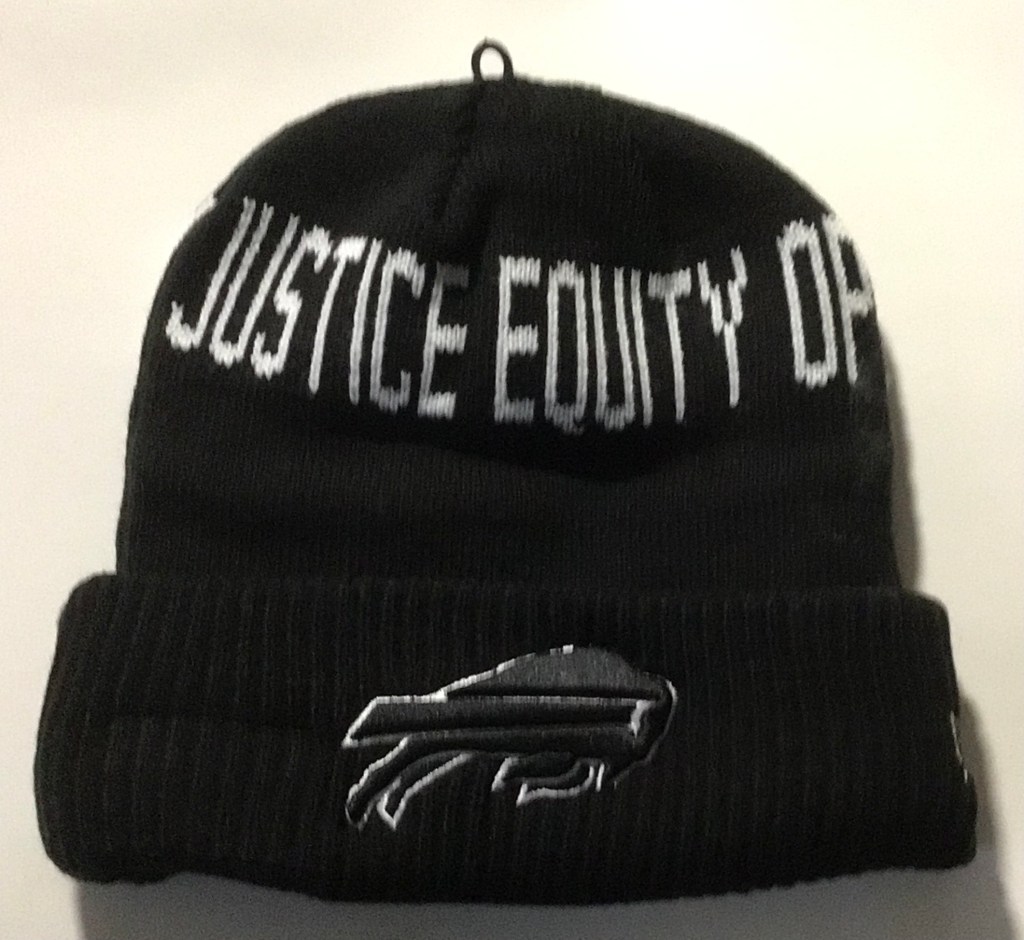
I live in Rochester, NY and the Buffalo Bills are having a great season, so I’m happy to jump on the Bills bandwagon. It is something that has united folks in upstate NY. I bought the following hat to show my support for the team and the social justice initiative. Justice and Equity are on the front of the hat and Opportunity and Freedom are on the back.

The only issue have with Buffalo Bills supporters is that fans are using the moniker “Bills Mafia” which I find offensive.

So there has been progress. The Bills have embraced the Inspire Change slogans and wear them on back of their helmets. And I can enjoy football again. I hope to watch the Buffalo Bills in the Super Bowl this year.

A Name Change

I often refer to the things that I care about as my Three Es: Equality, Environment, and Economic Justice. After some thought, I have decided to change the name of my blog to Equity, Environment, and Economic Justice. As I have learned more about DEI, I realized that treating everyone the same is not going to level the playing field. Some folks will always need a compensating factor in order to have a equal opportunity.

If you think about the kids of different heights watching the baseball game over the fence, giving them the same box to stand on will not do much good. For starters, some will need more boxes to stand on if they would like to see over the fence. Better yet, why not remove the fence? That is called justice.

Labor Day Thoughts

Labor is prior to, and independent of, capital. Capital is only the fruit of labor, and could never have existed if labor had not first existed. Labor is the superior of capital, and deserves much the higher consideration.

Abraham Lincoln, First Annual Message, December 3, 1861

To many Americans, Labor Day is an end-of-summer long weekend and an opportunity to have a picnic or barbecue, weather permitting. But it’s also a time to reflect on how the labor movement has improved our lives. You know, the folks who gave us the weekend. In conjunction with FDR’s New Deal, the labor movement helped to build the middle class.

During the Great Prosperity (the three decades after World War II), labor provided a counterbalance to capital, which broadened prosperity. But over the last four decades, labor has lost much of its power and wages for working-class Americans have been stagnant. Fifty years ago, a third of American workers belonged to a union and many employers offered comparable benefits to avoid unions. Today, about one in ten American workers belong to a union and most of these are in the public sector.

According to a recent Gallup poll, 68% of Americans are in favor of unions, the highest since 1965. Unfortunately, not every worker who wants to join a union has the opportunity, thanks to anti-union campaigns by employers and an increasing number of “right to work (for less)” states.

In a recent survey from Pew Research, 55% of U.S. adults say labor unions have a positive effect on the way things are going in the country. Fortunately, there is a generational breakdown where more millennials and zoomers can see the positive effect of unions on our society. And the Biden administration is the most pro-labor administration in decades. But in spite of this, the PRO Act is still a heavy lift because of Republican obstruction in the Senate.

In America, we devote one day each year to honor labor. On the other 364 days, capital is given preferential treatment. But lately there has been an uptick in union activity, which gives me hope for a better America.

Hard and Soft Infrastructure

After summer recess, Congress will get back to work on two infrastructure bills. One will deal with hard infrastructure (roads and bridges) and will have bipartisan support. It’s certainly needed because the American Society of Civil Engineers report card has given us a C-. While we have been busy burning up $2 trillion dollars in Afghanistan, China has built up their infrastructure to 21st Century standards.

But the other infrastructure bill, which hopefully will pass on Democratic support alone, deals with soft infrastructure. In other words, investing in people. Early education, post-secondary education, help for caregivers to help them be more productive. Yes, the price tag is high, but so was the 2017 tax giveaway that the GOP passed on a party line vote.

But one more time for the people in the back with their fingers in their ears: it’s investing in people and quality of life. It’s a plan for a happier, healthier, more productive America instead of a scheme to make rich people richer.

Four Americas and Equal America

I recently read an essay in the Atlantic by George Packer on how America has been fractured into four tribes: Free America, Smart America, Real America, and Just America. Free America is Reagan’s vision of America and is built on a religious faith in markets. Smart America is the meritocracy, well-educated experts, the coastal elites. Real America is the hard working folks in the heartland who have been left behind by economic change. Just America are folks who have been left behind by systemic injustice. Think Black Lives Matter.

My head aligns with Smart America and my heart aligns with Just America. I don’t have a problem with free enterprise until it turns into greed. But there are several reasons I am philosophically opposed to Free America: it’s anti-government streak and aversion to taxation, even for necessary things. Hatred of government and aversion to taxes are why we can’t have the good things that other developed countries enjoy.

The problem that I have with Real America is their contempt for elites and knee jerk rejection of expert opinion. The sheeple just gobble up misinformation and disinformation from right-wing propaganda machines and think that they are thinking for themselves. I really should have more empathy because they have been left behind by economic progress, but politicians use them to maintain a tyranny of the minority. I consider the anti-majoritarian structure of our government a bug rather a feature, and the right wing has leveraged it to the max.

Smart America are the folks that I want to be in charge. They are highly-educated and understand policy. The downside is that many of the elite are members of the lucky sperm club and have had advantages in life. Yes, they got there because of hard work but they also had better access to opportunities.

Packer’s critique of Just America is that it has devolved into identity politics. But my opinion is although America is not a racist country in theory, in practice not so much.

Over the past forty years, Free America (Reagan and the Bushes) has been the dominant ideology. Smart America (Clinton and Obama) has also had its turn. In four short years, Real America (Trump) has polarized the country to the point where democracy is threatened. My hope is that when the millennials and zoomers take over, Just America will have its turn in the sun.

The four Americas have both good and bad traits and Packer’s premise in the Last Best Hope is that the four rival groups can be integrated and our better angels will create an Equal America.

Bad Advice from “The Graduate”

There is a famous line from the 1968 film “The Graduate” where Mr. McGuire gives Ben (played by Dustin Hoffman) one word advice about the future: “Plastics”. Plastic packaging and consumption has certainly grown over the last fifty years. The milkman doesn’t deliver milk in glass bottles and kids don’t collect pop bottles for candy money anymore (although garbage pickers still check for plastic bottles that have a deposit).

The Summer 2021 issue of Yes! magazine is The Solving Plastics Issue and it discusses steps individuals can do to move towards zero waste. The size of the Great Pacific Garbage Patch is mind-blowing and much of it is microplastics, which are creating environmental havoc.

What can consumers do? Avoid beverages in plastic bottles is a small step. I enjoy ice tea in plastic bottles, so one step I can take is to make ice tea in a pitcher. And there are a couple of dairies that sell milk in glass bottles, but I would have to drive a few extra miles in my Prius to buy it.

If you have a baby at home, you can choose a cloth diaper service instead of using disposables. We used one when my daughter was little and it feels good to give your baby cotton diapers.

I’m pretty religious about putting empty plastic containers in the blue recycling box. But the problem is, do they get recycled? Without a buyer for recycled plastic, plastic waste ends up in the landfill.

But to prevent plastics from ending up in landfills, on beaches, and in the oceans, it’s going to take more than individual effort. The onus needs to be on manufacturers. While it true that some items still need to be made from plastic, consumer choice can play a role which means things will be a little more expensive.

Annie Leonard, the founder of the Story of Stuff project reminds us that there is no such place called Away. You won’t be able to find it on a map. But it’s there. In the Great Pacific Garbage Patch and other patches created by ocean gyres.